Processes – Certificate issuance
Here you will find information on the process for issuing class B certificates.
Class B certificates are issued by LRA officers in a synchronous or asynchronous process.
You can find the process descriptions, quick guides, forms and other documents at Class B - Forms and documents library.
You can find the process descriptions, quick guides, forms and other documents at Class B - Forms and documents library.
Synchronous issuance – LRA officer
Request and issue smart cards and certificates using the synchronous issuance process.
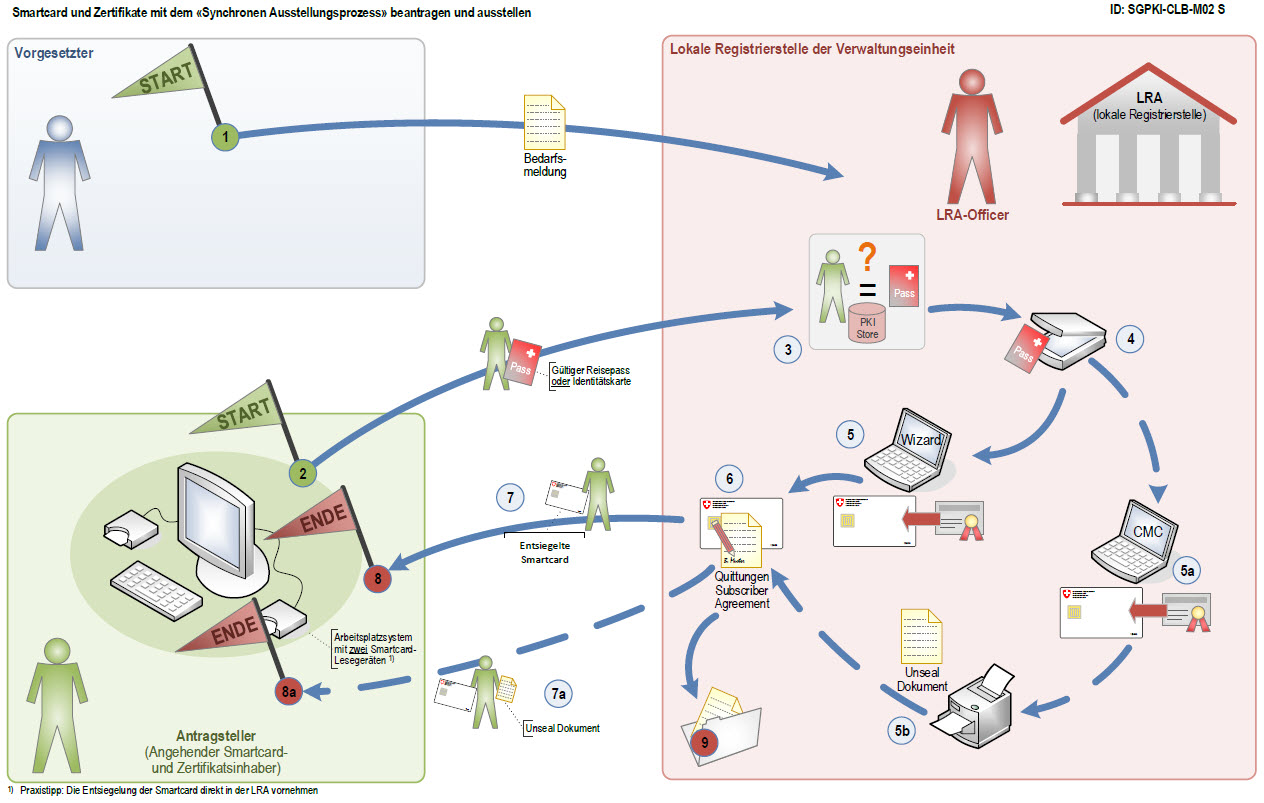
- With synchronous class B smart card issuance, the requester/end user is invited to a personal meeting with the LRA officer, to which they must bring their currently valid travel documents (ID card or passport).
- The LRAO verifies the requester's identification.
- The class B certificates are then loaded onto a prepared smart card that is equipped ("prestaged") with key material.
- During this process, the keys are signed and the certificates personalised.
- For this purpose, the LRAO uses the Walk-In Wizard tool, which also offers the option to unseal the user card.
- The requester/end user enters their own PIN.
Asynchronous issuance – RIO
Request and issue smart cards and certificates using the asynchronous issuance process.
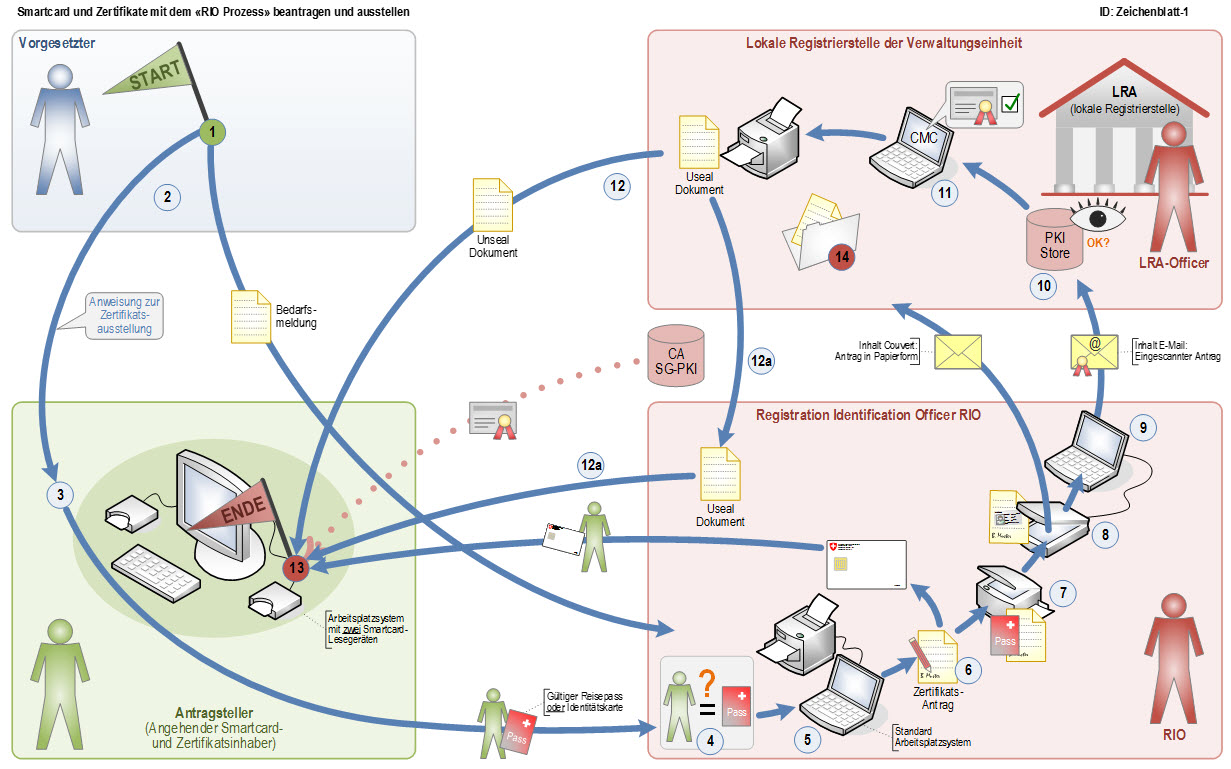
- Issuance via the so-called RIO process is mainly relevant for offices and organisations affiliated to the Confederation that are located on several sites. This process allows personal identification and card issuance to be locally isolated while performing the issuance process securely.
- When instructed to do so by their line manager or HR unit, the certificate recipient/end user goes in person to the responsible RIO. The RIO identifies them by means of a valid travel document (ID/passport) and enters the personal details, and especially the serial number of the prepared smart card, in a certificate request.
- The verified travel document (ID card/passport) is copied onto the printed request (see below). The resulting document is signed by both the RIO and the certificate recipient/end user. The RIO then hands over the smart card to the certificate recipient – note that the card is not yet personalised and does not contain a certificate – and the recipient signs a receipt together with the subscriber agreement. The RIO scans the request documents and sends them in an email, which the RIO signs with their own class B certificate, to the responsible LRA officer.
- The LRA officer checks the request and then issues the personal certificate for the certificate recipient/end user. As part of this process, an eTicket is automatically generated in the system. The LRA officer uses the generated eTicket number to print out the unseal document and sends it, either by post to the certificate recipient's/end user's private address or by signed and encrypted email to the RIO for forwarding to the certificate recipient.
- The certificate recipient/end user can now use the smart card and the eTicket number to launch the unseal wizard at a workstation with two card readers, and unseal their smart card (see sub-process Unseal class B smart card) in the «Token unseal» menu. Their certificates are written onto the card and the PIN is set. The card is now ready for use.