Swiss Government Cloud
With the Swiss Government Cloud (SGC), a new hybrid multi-cloud infrastructure tailored to the requirements and needs of the Confederation is to be set up at the FOITT between 2025 and 2032. It will consist of three cloud levels. The SGC is geared primarily to the needs of the Confederation, but is also available to the cantons and communes. With the publication of the tender documentation, the SGC programme has reached an important milestone and entered its next key phase. The aim is for the first call-offs to be possible by late autumn 2027.
Brief summary
With the SGC, a hybrid multi-cloud infrastructure is being established at the FOITT. A commitment appropriation of CHF 246.9 million was requested for this purpose. In total, the project will cost CHF 319.4 million. The SGC is designed to meet the requirements and needs of the federal authorities. However, the cantons and communes should also be able to benefit from the offering if they are interested. By contrast, no services will be provided for the private sector via the SGC.
The SGC is a programme that is unique in terms of its scope and significance for federal IT, and the procedure is correspondingly demanding. The programme has reached an important milestone with the publication of the tender documentation (“WTO 25002 609 Swiss Government Cloud” and press release). The first call-offs are expected to be possible by late autumn 2027.
Background
Digitalisation is increasing the demand for innovative IT solutions and calls for IT infrastructures that meet higher performance, reliability and security requirements. In order to respond to this development, the federal government intends to focus more on cloud solutions. To create the basis needed for this, the Federal Council adopted the Federal Administration's cloud strategy on 11 December 2020. This envisages a hybrid multi-cloud approach, which means that federal authorities should be able to obtain both internal federal cloud services and cloud services supplied by several external providers, and also combine them.
The federal government took a first step towards implementing the cloud strategy in 2022 with the Public Clouds Bund procurement procedure, which supplemented the Federal Administration's existing private cloud offering with public cloud offerings from external providers. The SGC is the next stage in the implementation of the cloud strategy.
Project content
With the SGC, it is planned to set up a new hybrid multi-cloud infrastructure tailored to the requirements and needs of the Confederation. Combining both public and private cloud offerings, it is to provide the Federal Administration with a uniform global solution for most of its cloud activities. It will also replace the FOITT's existing cloud offerings.
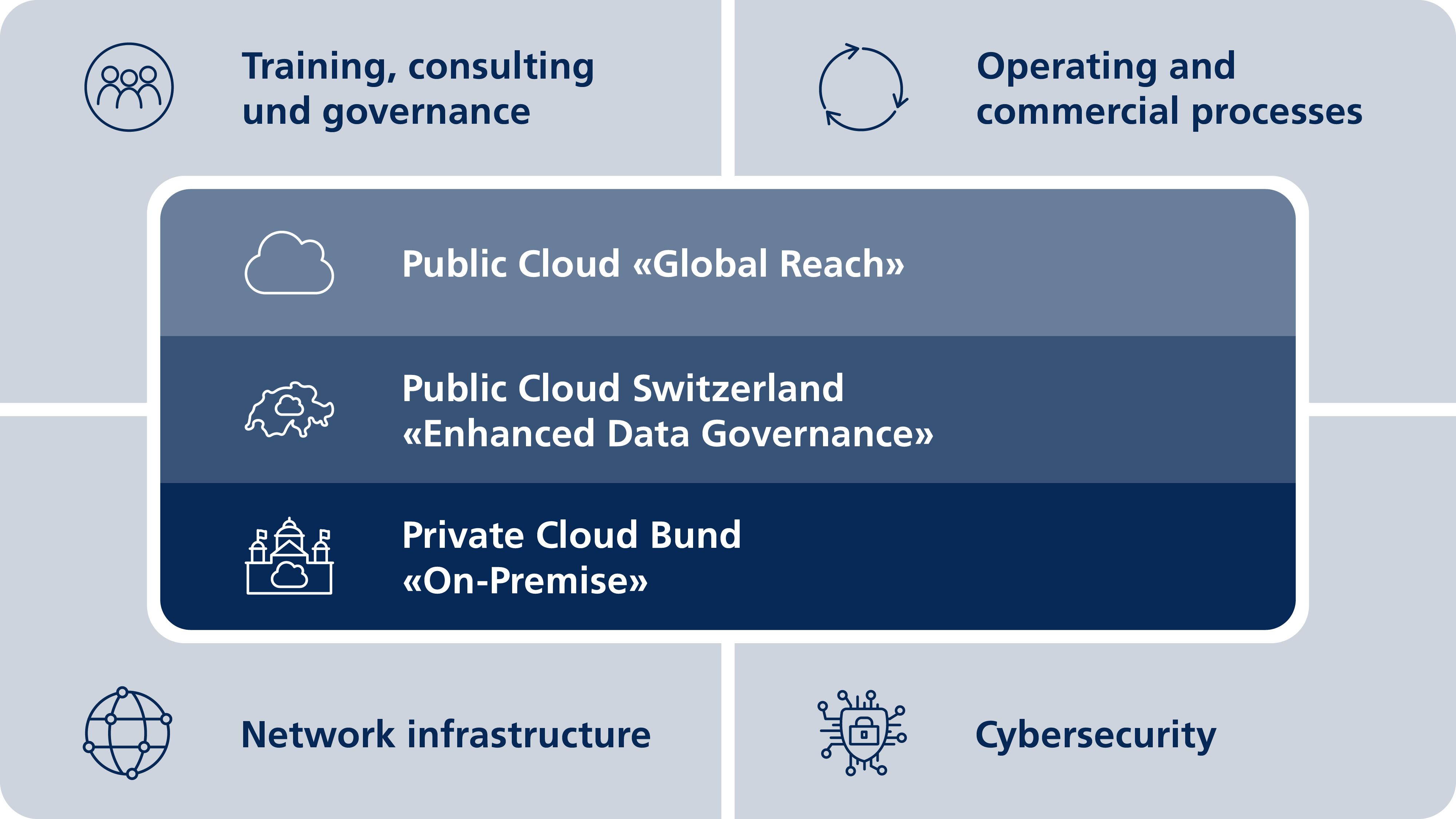
To ensure that the SGC can be developed and used in a targeted manner, a holistic approach is being pursued. Overall, investments in five key areas are planned:

The project at a glance
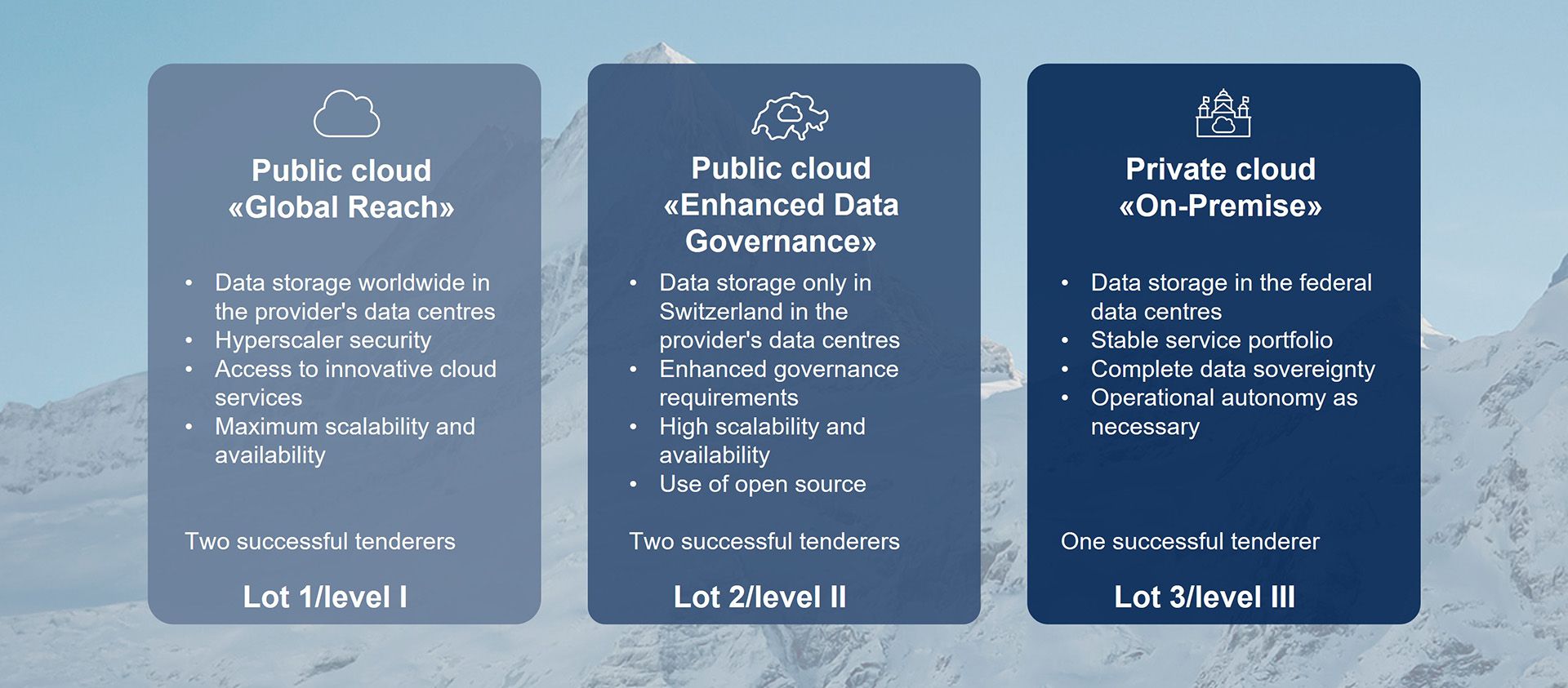
With its hybrid multi-cloud approach, the SGC deliberately focuses on combining different cloud levels. The requirements regarding innovative services, security and digital sovereignty vary from level to level. The invitation to tender is divided into three lots, which correspond to the SGC's different cloud levels.
Cloud level I: Public cloud – global reach (lot 1) comprises innovative, flexible and scalable cloud services from providers with global reach. It is particularly suitable for use cases that benefit from modern cloud technologies and high scalability.
Cloud level II: Public cloud – enhanced data governance (lot 2) meets enhanced governance requirements and enables targeted control of access rights. It relies on open source solutions and ensures that data is stored and processed exclusively in Switzerland.
Cloud level III: Private cloud – on premises (lot 3) offers standardised services with a high level of control for particularly sensitive applications. Data is stored and processed solely in the federal data centres. This level guarantees the highest degree of data sovereignty by means of technical, organisational and contractual measures. In addition, operational autonomy can be ensured as necessary.
In the invitation to tender, the requirements for the three cloud levels are translated into specific eligibility and award criteria, and will be evaluated in compliance with applicable public procurement law.
Aside from the hybrid cloud infrastructure, the SGC also includes the expansion of the network infrastructure, the expansion of cybersecurity, a comprehensive range of consulting and training services and the automation of operating and commercial processes.
Expansion of the network infrastructure
The network infrastructure is crucial to the success of the digital transformation, as it forms the basis for all the services provided by the FOITT's current and future hybrid multi-cloud infrastructure. With the increased use of cloud services in the hybrid cloud model, the requirements for a modern network infrastructure are also changing, e.g. in terms of available bandwidth, automation and security. For this reason, the network infrastructure will be expanded accordingly as part of the project.
Expansion of cybersecurity
The aim of cybersecurity is to prevent the misuse and disruption of the IT resources used to perform statutory tasks. However, the challenges in this regard have changed radically: while IT systems used to be operated centrally in data centres and workstations were located in federal buildings, today's technology enables employees to work anywhere and to access the federal network using various devices, a process in which the use of the public cloud is also growing in importance. Implementing the hybrid multi-cloud strategy therefore entails new cybersecurity challenges. In order to meet these challenges, the cybersecurity area for action will ensure that data protection is adapted to the new circumstances.
Operating and commercial processes
The growing momentum in the digitalisation environment requires industrialised and highly automated solutions for the technical operation of the hybrid multi-cloud environment (operating processes) and for order processing (commercial processes). Consequently, the entire process chain will be analysed, adapted and, where possible, automated within the framework of the operating and commercial processes area for action.
Training, consulting and governance
Administrative units should be able to use the SGC in a secure, efficient and targeted manner. The training, consulting and governance area for action will ensure that comprehensive support is available for the use of the hybrid multi-cloud environment if needed. To this end, training and consulting services will be developed and SGC-wide cloud governance established.
Benefits
When using cloud services, it is always necessary to weigh up various requirements in the areas of data protection, information security, digital sovereignty, functionality and cost efficiency. With its three-part solution, the SGC can cover the various requirements and needs of the administrative units to the extent necessary. SGC-wide governance will ensure that solutions operated in the SGC can be integrated into the federal system landscape as easily as possible, thereby reducing costs and allowing valuable resources to be invested in the digitalisation of business processes.
Furthermore, by providing access to innovation, the SGC will enable the Confederation to reap the benefits of digitalisation. Its digital resilience will also be strengthened, as customers will be able to respond quickly to new developments in the business environment thanks to appropriate cloud-based solutions. Regular investment will help ensure that the SGC also meets the Confederation's digitalisation needs in the long term. Data protection and information security are key core requirements for the future IT infrastructure and are therefore given priority. Overall, the SGC will establish an appropriate technical basis for efficiently implementing the main upcoming digitalisation projects of the federal government, and thus make an essential contribution to its digital transformation.
Cantons, cities and communes shall also be able to benefit from the service if they are interested. By contrast, no services will be provided for the private sector via the SGC.
Financial implications
The requested commitment appropriation amounts to CHF 246.9 million. In total, the project will cost CHF 319.4 million, which also includes the FOITT's own work and investments over the entire duration of the programme, as well as expenditure incurred already in 2024 for preparatory work.
Timeframe
The project will be carried out from 2025 to 2032. The first SGC offerings, such as training and consulting services, will be available as early as 2026. The first SGC functionalities ready for production use will be available in 2027. Migration can begin as soon as the procurement procedure has been completed. The migration work is expected to be completed four years after the first migration. Optimisation and further development work will be carried out on the SGC already during the migration and through to the end of the project in 2032, so as to ensure that the solution remains fit for purpose and innovative.
Procurement: invitation to tender, procedure and timeline
The invitation to tender entitled “WTO 25002 609 Swiss Government Cloud” published by the FOITT fulfils not only the objectives set out in the dispatch on the establishment of the SGC, but also the parliamentary purpose clause in the federal decree on the commitment appropriation. It does not prescribe any specific providers, products or technologies and has deliberately been designed to be open, thereby creating a level playing field for all tenderers. The invitation to tender therefore offers a wide range of opportunities for interested companies in Switzerland. Furthermore, the criteria set out in the directives on digital sovereignty in the Federal Administration are taken into account in the invitation to tender.
With its hybrid multi-cloud approach, the SGC combines three coordinated cloud levels, each geared to different requirements of the public administration in terms of innovative potential, protection requirements and digital sovereignty. The invitation to tender translates these requirements into specific eligibility and award criteria.
The procurement is being conducted as a selective procedure with a lot limitation, which ensures that no tenderer may be awarded more than one lot. This strengthens digital sovereignty by reducing dependence on individual providers and jurisdictions.
Awards
For each of the two public cloud levels, contracts will be awarded to two tenderers. In the case of the private cloud – on premises, the contract will be awarded to only one tenderer. Each award has a duration of seven years, as the market is reopened to competition every seven years. The total contract duration is 14 years, so that applications can be operated for at least seven years, including migration.
The procurement volume
The optional procurement volume amounts to a maximum of CHF 2 billion for each of lots 1 and 2, and a maximum of CHF 3 billion for lot 3. The volumes are allocated to the individual lots on a binding basis and cannot be transferred between lots at a later stage. The calculation of the total procurement volume (7 bn) is based on the current federal expenditure on cloud-related services, the needs of the cantons and communes derived from that expenditure, and the expected growth driven by ongoing digitalisation. This volume should be understood as the maximum that can be procured over the entire 14-year contract duration.
Principle of pay as you use
The optional procurement volume sets an upper limit on what may be procured and should not be equated with costs. Future users will generally pay solely for what they actually consume. The principle of pay as you use applies, so costs are incurred only for the resources actually used. The SGC is primarily designed to meet the requirements and needs of the federal authorities, but the cantons and communes should also be able to benefit from the offering if they are interested.
Timeline
The selective procurement procedure consists of two phases: a prequalification phase (60 days from the publication date) followed by a bid phase. Provided there are no objections with suspensive effect, the awards are expected to be published and the contracts concluded in late summer 2027. The first call-offs could then take place in late autumn 2027. According to the dispatch, the programme is scheduled to be completed in 2032.
Index
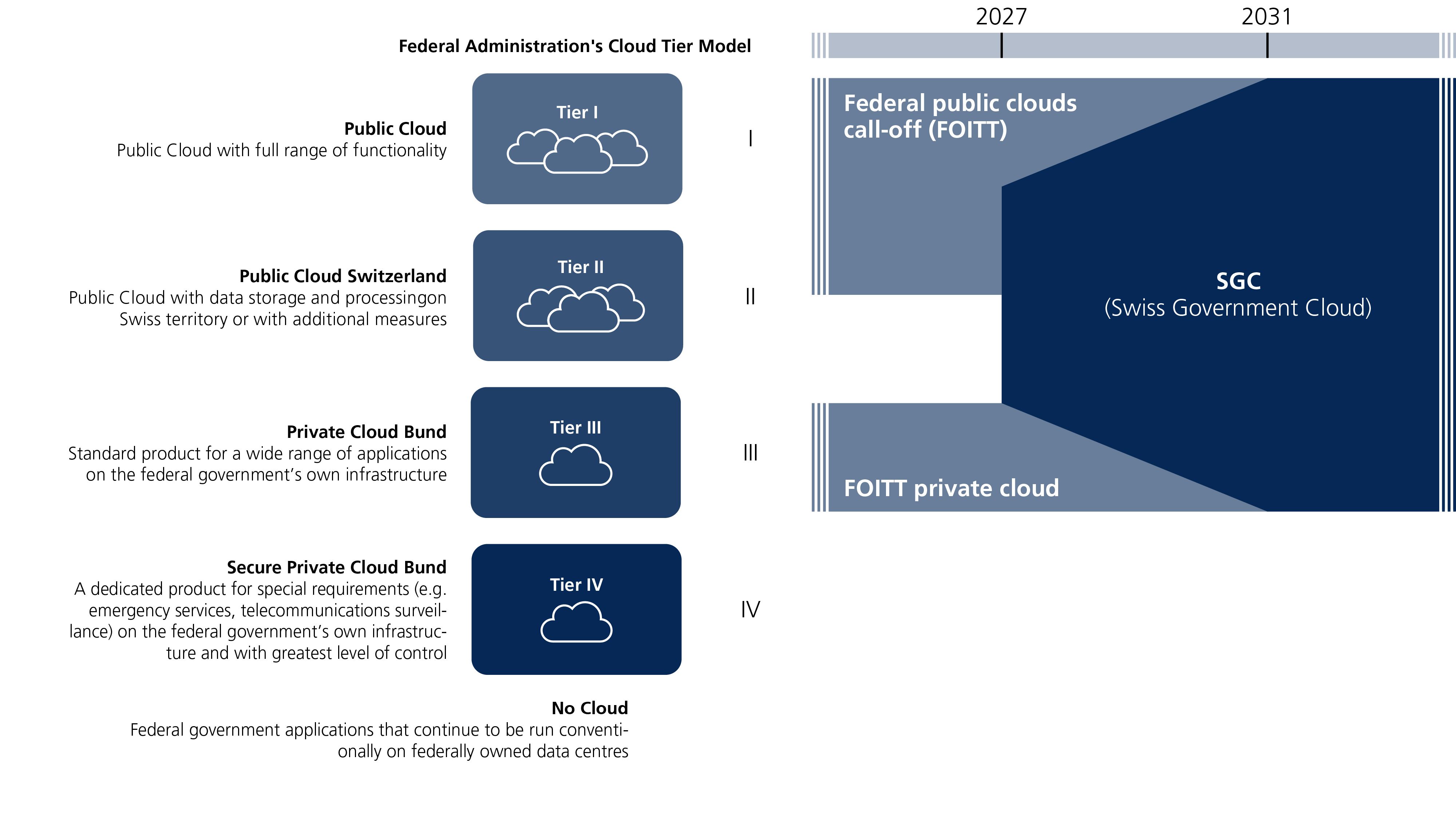
The SGC in the context of the Federal Administration's cloud strategy
The SGC is based directly on the Federal Administration's cloud strategy adopted by the Federal Council on 11 December 2020. It is the result of the implementation of this strategy at the FOITT. It constitutes a global solution for most of the Federal Administration's cloud activities and in the future will cover its cloud levels I, II and III.